Introduction > Timber drying kilns > Compartment drying kilns > Components of drying kilns

Components of chamber drying kilns

Reversible axial fans for drying kilns

The drying air circulation is provided by reversible axial fans with a diameter from 630 to 1600 mm. Fans can perform same efficienty and capacity in both rotating directions and at any revolution rate. Possibility to adjustment speed of air flow with intelligent frequency converter ECO TRONIC benefit you by outstanding power saving. The motors are tropically insulated to resist high temperature and to work without any problems in environments reaching 100 % of moisture content.

Air flowing speed in the drier can be controlled using one of three methods depending on the drier equipment.

  • Eco Tronic – intelligent control of the flow speed based on the course of moisture decrease of the timber being dried and based on scanning of the true course of air saturation in the piles and change of its condition
  • Contact – allows to inactivate part of the circulation fans in the given drying process part, pursuant to the control system program
  • Frequency converter – allows fluent change of the flow speed pursuant to the course of the timber moisture decrease and ability of taking the moisture away from the timber surface

More photos of reversible axial fans for drying kilns.

Reversible axial fans for drying kilns


Detail of reversible axial fans for drying kilns

Air Baffles / Flaps for drying kilns

To direct and improve the air flowing control and to reduce the flow losses, the drier chambers are equipped with a ceiling flap and side flaps. The ceiling flap is formed by one or two gum-textile bands, the side flaps are made of stainless metal-sheet. The correct position of side flaps is ensured using special arresting mechanisms.

More photos of air baffles or flaps for drying kilns.

Air Baffles / Flaps for drying kilns 

Vents – air renewal system for drying kilns

The air exchange system is formed by two rows of vents in the roof ceiling of the chamber. They ensure the supply of fresh, dry air, and removal of the air saturated with evaporated water. The vents are manufactured from aluminium and each are equipped with a regulating valve, which is operated automatically by a servodrive system. The air exchange system can be connected with recuperation unit, which provide preheating of suction air and saves a part of heat energy.

Vents – air renewal system for drying kilns

Heating Registers – Radiators for drying kilns

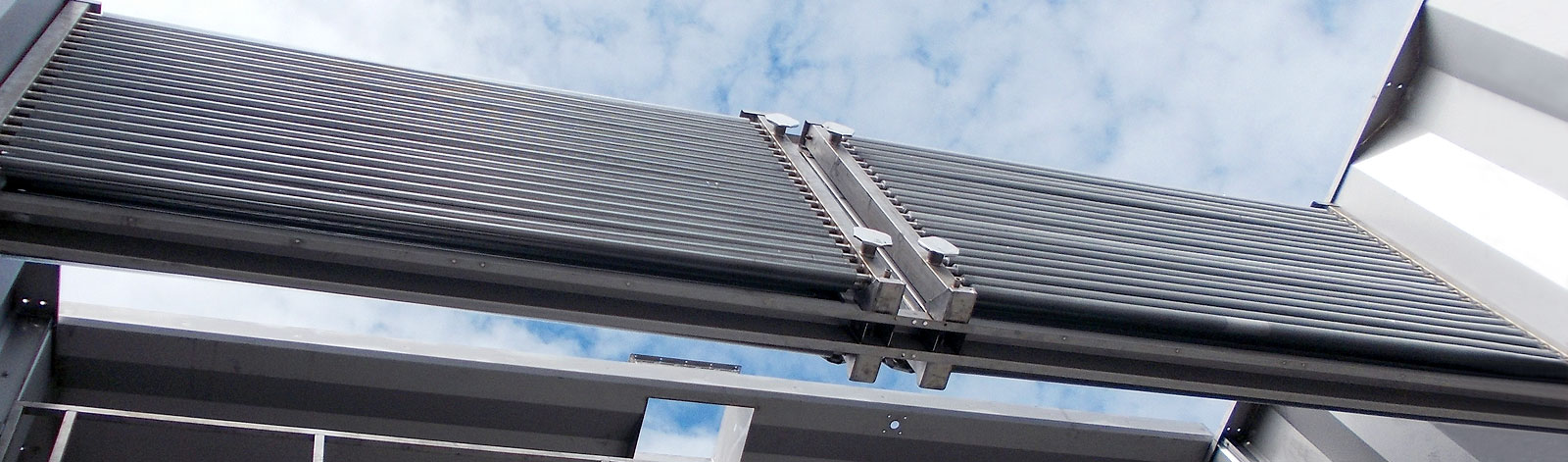
Heating coils elements are made from stainless steel pipes with aluminum fin . The overall diameter of the heating element coil is 60 millimeters. The coils are joined into the stainless steel collector which is connected to the incoming and returning piping of the heating system. The heat output of the heating elements is designed for the maximum necessary heating power .

As a standard, the heating registers are placed in the horizontal position, up, above the inter ceiling (false ceiling) level, but on the customer request we could prepare vertical positioning as in this KATRES reference.

More photos of heating registers for drying kilns.

Heating Registers – Radiators for drying kilns


Detail of Heating Registers – Radiators for drying kilns 

Humidification system for drying kilns

The humidification system consist of a stainless steel distribution piping with specially designed moistening nozzles. Normative water is used as a moistening medium. The system is equipped with rough and fine filter.

  • For most common low-pressure humidification the water pressure should be minimally 0.2 MPa (regular water pipeline).
  • High-pressure humidification offers superior water diffusion with work pressure 3–10 MPa.
  • It is also possible to moisten with saturated steam with overpressure 0.1 MPa and temperature of 120 °C.
Humidification system for drying kilns

Monitoring the drying atmosphere

Two basic parameters of the drying air (temperature and relative humidity) are measured in the drying section of the chamber. For their measurement, it is possible to use the:

The above approach is to provide the measurement of the temperature and relative humidity of the drying environment. The selection of the type of measurement depends on the concrete conditions and requirements of each customer.

More photos of monitoring the drying atmosphere.

Monitoring the drying atmosphere 

Measuring of timber moisture

In each chamber, the humidity of the wood is being measured, in the process of drying, with the help of resistor probes. Connecting these probes to the control system is achieved via cables brought to the terminal. The second possibility is the use of probes with micro transmitters so it´s wireless transfer of informations.

Measuring of timber moisture

Related links

 
SitemapAbout web   |   Print page
created by Omega Design